When we think of oil, it is usually with reference to furnace oil – gasoline and diesel which keep our cars and trucks on the road. While oil, being an important source of energy, has become important for the modern civilization, its impact on environment cannot be ignored.
In addition to the pollution caused by the combustion of oil and its by-products, oil spills are a major source of pollution. An oil spill is the release of oil (generally petroleum or crude oil) into the natural environment, usually in the sea, following accidents involving tankers, barges, pipelines, refineries and storage facilities, usually while the oil is being transported. Complete recovery of the habitat is projected to take more than five years. The special ecology of the affected area increases the significance of the oil spill with reference to global ecosystems.
The causes of oil spills vary and may involve a combination of reasons and conditions. Oil spills may be caused by:
— Human error: improper equipment use, poor communication, and failure to follow procedures;
— Equipment failure: a mechanical, structural or electrical failure related to installation, operation or maintenance;
— Natural elements: storms, hurricanes, fog, tidal conditions and floods, etc;
— Others: deliberate acts of sabotage, war, vandalism or illegal dumpers.
When oil spills out of a ship, it is warm and floats easily on the surface. While some of it naturally dissipates, the rest cools down to the temperature of the water, gradually congealing into thumbnail-sized “tar balls” that either sink into the water column or continue to float. Unless contained by a boom or barrier, this oil spreads rapidly.
The environmental impact of an oil spill depends upon the type and amount of oil spilt, climate conditions and season, the local biological conditions and the speed of recovery. Since oil is a natural substance, it may disperse and eventually decompose through natural processes if conditions are favourable.
However, crude oils and petroleum products are made up of chemical compounds that can cause considerable damage. These products may poison and kill microscopic plants and animals that are at the bottom of the marine food chain.
The most hazardous components in oil tend to be those that are lost rapidly through evaporation when oil is spilt. Some species are susceptible to the toxic effects of inhaled oil vapours, which can damage the animals’ central nervous system, liver and lungs. Animals are also at risk from ingesting oil, which can damage the cells in the intestinal tract and reduce their ability to eat or digest food.
Fish ingest large amounts of oil through their gills. If this does not kill them directly, it can inhibit their ability to reproduce or can result in deformed offspring. Especially vulnerable are slow-moving shellfish, such as clams, oysters and mussels, as they can’t escape from an oil slick. These creatures routinely filter large volumes of seawater to extract food and are especially likely to accumulate oil components.
While these components may not cause any immediate harm, their presence may render such animals unpalatable. Some crude oils may also leave a sticky residue that can float to the surface or to the shore. This oil residue and the water-in-oil emulsions may stick together and form small balls of tar, which may suffocate sea animals and seaweed.
If a coating of thick oil covers a seabird, it may kill it either by poisoning it, or altering the system that controls body temperature. Oil can also be transferred from the bird’s plumage to the eggs they may be hatching and can lead to reproductive problems. The oil can also smother the eggs by sealing the pores and preventing gaseous exchange.
While the physical nature of oil (contamination and smothering) or by its chemical components (toxic effects and accumulation leading to tainting) can adversely affect marine life, the indirect physical damage due to clean-up operations may also bring harm to the habitat. In addition to the harmful ecological outcome, oil spills can have a negative socio-economic impact on the area hit.
Contamination of coastal areas is a common feature of oil spills, leading to public disquiet and interference with recreational activities, such as bathing, boating, angling and diving. Secondly, it can cause a loss of confidence, as bans on fishing and export of seafood from the region may be imposed following a spill.
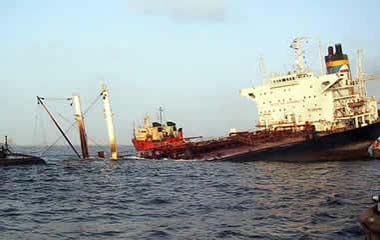
In today’s globalized world, no country with a coastline is completely safe from the risk of an oil spill. Pakistan suffered its worst environmental disaster in the form of a major oil spill in August 2003, when MT Tasman Spirit — an oil tanker registered in Greece that flew a Maltese flag — drifted off-course, ran aground and in the process developed cracks.
The tanker continued to leak oil for more than 21 days and the Karachi Port Trust could recover only about 36,000 tons of oil from the ship. An estimated 31,000 tons of oil was spilt in the shallow marine waters of the coast. The worst hit areas were Clifton and the Defence Housing Authority beaches, the harbour and the areas adjacent to the coastline.
Two years have passed since the environmental disaster. For many Karachiites, the event became a distant memory soon after the beaches had been cleaned up. However, the spectre of the Tasman Spirit (no pun intended) continues to haunt the region in the form of long-term ecological effects.
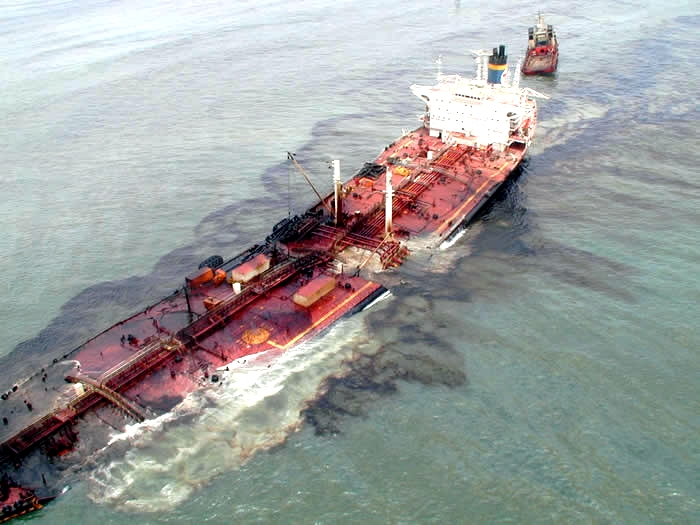
According to the “Tasman Spirit oil spill natural resource damage assessment summary report”, it is estimated that about 11,000 to 12,000 tons of volatile organic compounds evaporated into the air. However, due to the vigorous mixing because of strong monsoon winds, a substantial part of the spilt oil — an estimated 16,000 tons — combined with suspended sediments in water and settled at the seabed in a vast sub-tidal area of about 217sq km, where it is expected to remain for several years — until nature takes its toll and degrades it.
The report says that full recovery of the marine habitat is projected to take five to 10 years, that is, until all of the spilt oil currently residing in the seabed is gone or stops leaching into the water column above. The special ecology and fauna of the region increase the significance of the oil spill, with reference to the local as well as global ecological systems.
The coastal environment in which the Tasman Spirit was grounded is rich. The diverse tropical marine/estuarine ecosystem there includes mangrove forests, nesting beaches for rare turtles, while dolphins, porpoises, beaked whales and about 200 species of fish are known to exist in the area.
The oil spill affected the commercial fishing area of approximately 2.062sq km, where seawater analysis has revealed extensive hydrocarbon contamination. Since the fish eggs and larvae are particularly susceptible to petroleum hydrocarbons, this is likely to result in a decrease in the quantity of fish.
However, this is just one long-term outcome of the oil spill. According to Moazam Rabani, the director-general of the National Institute of Oceanography: “The carcinogenic Polynuclear Aromatic Hydrocarbons (PAHs) released to the sea as a result of the oil spill are absorbed by micro-organisms and planktons.
“These organisms make up the lowest strata of the food chain, being food for larger fish and other sea animals. This way these carcinogenic compounds become part of the food chain and are transferred from lower trophic level to the higher trophic level. When humans consume the fish and the seafood carrying PAHs, these carcinogenic compounds enter the human body and (may) cause diseases.”
According to the aforesaid report, although the surface oil slick did not migrate westwards to directly impact the turtle-nesting beach at Sandspit, the possibility of a shift in the sub-surface current direction in the non-monsoon season from east to west has the potential to cause hydrocarbon contamination of the beach. Other studies have stated that many hatchlings starved to death after they swallowed petroleum tar balls.
Evidence of PAHs was discovered in the blood samples and eggs of sea turtles collected during the 2003 nesting season. The presence of the chemicals can result in reduced reproduction of these endangered species and affect the sea turtle population in the long run.
The mangrove forests in the coastal areas play an important role in maintaining the ecological balance and provide a diverse habitat for a complex and interdependent community of invertebrates, fish, birds, and reptiles. The immediate impact of the oil spill on mangroves was observed in the form of the death of seedlings or propagules of Avincennia marina, the dominant species of mangroves in the Manora Channel.
However, since oil entered the mangrove forests during high tide, it was deposited on the aerial roots and sediments when the tide receded and affected 786 hectares (2,435 acres) of the forest area. The oil penetrated the sediments, killing crabs and worms and destroyed trees, which in turn led to a loss in the forest cover and a reduction in the growth and population of all species in the zone. This is expected to result in a loss of 2,526 tons of shrimps and fish per year.
Meanwhile, the oil spill revealed the complete absence of adequate measures and contingency plans to deal with an environmental catastrophe of this nature. Two years on, what steps have the authorities taken to prevent a similar catastrophe?
According to Shamsul Haq Memon, secretary to the environment department, government of Sindh, “Unlike most countries, when the Tasman Spirit incident occurred on the coast of Karachi, there was no Emergency Response Centre to deal with the problem. However, after the incident proposals have been submitted to the ministry of environment and ministry of communication, for their approval, envisaging the setting up of a disaster management agency or an emergency response centre in order to deal with future problems or issues of this kind.”
Risks to the world ecosystem are nowhere greater than in marine environments where pollution has considerably damaged fragile zones, such as fisheries, mangroves and coral reefs. Studies have shown that one of the most significant sources of marine pollution is oil from ships and accidental oil spills along oil transportation routes.
To minimize the incidence of oil spills, there is a dire need for a sound monitoring and management system to prevent and control all activities that may cause or lead to the pollution of the marine environment. After all, prevention is better than cure.
A tragedy of errors
MT Tasman Spirit ran aground while entering Karachi Harbour in late July 2003. The vessel grounded about one mile offshore to the east of S7 buoy, when it was making its final turn into the port.
A pilot was on board the vessel at the time and weather conditions were not very favourable. The grounded vessel was held fast by the bow section, with the stern section remaining afloat. An operation to re-float the vessel, using six tugs operated by the Karachi Port Trust and Pakistan Navy, was launched soon. However, the vessel did not move and the attempts remained unsuccessful.
The grounding had occurred towards the end of the south-west monsoon season and the vessel was exposed to a four-metre swell hitting the vessel beam on.
July 27, 2003: Vessel runs aground; small release occurs.
July 28: Tugs attempt to refloat the vessel; a second vessel is dispatched to launch a lightering operation.
July 30: 2,000 tons of oil is released from the forward section in an attempt to refloat the vessel.
July 31: The tanker Endeavour II arrives for lightering.
Aug 1: Global Alliance placed on alert.
August 7: Lightering operation begins using the tanker Fair Jolly.
August 8: Oil washes ashore from the oil spilt during lightering.
August 10: The vessel’s condition deteriorates; ITOPF people arrive.
August 12: The Global Alliance mobilized.
August 13: The vessel breaks into two, spilling at least 12,000 tons of oil.
The lighterage operation, launched in the first week of August, took about 25 days to complete. Initially Fair Jolly (an 8000-ton ship) and Endeavour-II were used to transfer oil from the ship.
However, after Fair Jolly developed an irreparable fault, a 500-ton naval ship, PNS Gwadar, was pressed into service. Later, Sea Angel, a 6500-ton ship, was involved in the operation. Barges were also used for defuelling the vessel. During the course of the operation, the Tasman Spirit developed further cracks and kept spilling oil almost continuously.
This article was first published in August 2005, Sci-Tech World magazine published by the Dawn Media Group
 Reba Shahid