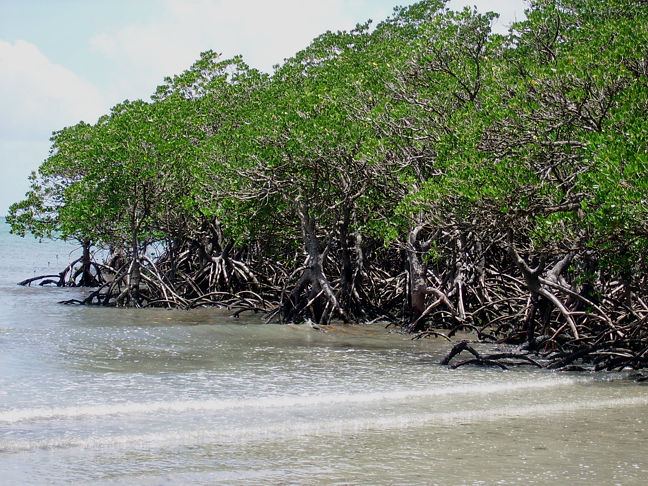
 A coastal city or community is crucially dependent on mangroves, the little islands of greenery, not only for maintaining the ecological balance and preserving the circle of life but also for the preservation and growth of marine life, which is subsequently a vital source of sustenance for fishermen. Mangroves help protect coastlines from erosion, storm damage, and wave action by acting as buffers, as soil binders and as a substantial physical barrier against the intensity of earthquakes and other natural disasters.
From a small fishing village to a bustling coastal metropolis, Karachi’s evolution over the decades has been phenomenal. While the country’s shoreline, particularly the port of Karachi, has been a boon with regard to the country’s trade and economic activities, this very coastline is also a treasure trove of flora and fauna.
However, the increasing human population and the sphere of human activities have had a detrimental impact on the delicate ecological balance that exists between mankind and nature. Influenced by the increasing burden of human activities and bearing the toll of mankind’s selfishness, (among other environmental elements), are the mangrove forests situated on Pakistan’s coastal areas.
Stretching on both sides of the Native’s Jetty bridge and along the area which now forms the Boating Basin, these scanty clumps of jagged, gnarled mangrove trees protruding from the surface of the sea, with roots embedded in deep, black, foul-smelling mud, may be an inconspicuous part of the scenery but, in reality they are one of the primary and crucial features of the coastal ecosystem. This stretch of mangroves is now connected through the Mai Kolachi Bypass, which runs through the mangrove forests of the eastern backwater at the head of the Chinna Creek.
Mangrove forests are unusual ecosystems, literally living in two worlds simultaneously. They are salt-tolerant evergreen forests which occur in the transition zone between dry land and the open sea. Looked at from the waterside they are quite unique, with their high stilted tree trunks giving the impression of being afraid of the water. At low tide, when their stilt roots are uncovered, one can see crabs and shrimps crawling around, and mollusks, oysters and snails of all kinds living attached to the roots, while birds patiently look out for prey. During high tide, they seem half submerged in the mix of sweet and saline water, which is considered as the natural breeding ground for these trees.
A coastal city or community is crucially dependent on these little islands of greenery, not only for maintaining the ecological balance and preserving the circle of life but also for the preservation and growth of marine life, which is subsequently a vital source of sustenance for fishermen. The stability mangroves provide is of immense importance. They can help protect coastlines from erosion, storm damage and wave action by acting as buffers and catch alluvial materials, thus stabilizing land elevation by sediment accretion that balances sediment loss. They act as soil binders and as a substantial physical barrier against the ferocity and intensity of earthquakes and other natural disasters.
Besides acting as the fine line of defence against hurricanes, typhoons, earthquakes and cyclones, mangroves act as a nursery or breeding ground for fish, shrimps, shellfish, oysters, sponges, crabs and snails. They also act as sanctuaries for marine life and are important sources of inshore fisheries.
The reason for this being the extensive root system of the mangroves which provides protection for juvenile shrimps and fish. In addition to this the forest detritus, consisting mainly of fallen leaves and branches from the mangroves, provides nutrients for the marine environment and supports immense varieties of sea life in intricate food webs associated directly through detritus or indirectly through the planktons and epiphytic algal food chains.
Formed in estuaries and muddy inlets on tropical coasts, mangrove swamps often serve as the border between dry land and the sea. In Pakistan there are three patches of mangroves in the province of Balochistan in Sonmiani, Kalmat and Jiwani, while the Indus Delta has swamps at Sandspit, Rehri and Keti Bandar. The Indus Delta mangroves are the biggest arid climate swamps in the world and Avicennia marina is the major species called “Timer” in Sindhi language.
Pakistan’s mangroves are also frequented by about 30,000 migratory birds, which come here to save themselves from harsh Central Asian winters. Among the birds that visit mangroves are gulls, coots, terns, dalmatian pelicans, flamingos, osprey dowitchers, dunlin, oystercatchers, waders and ducks. Birds that are permanent residents of the mangroves are herons, egrets, black-winged stilts and cormorants.
Over the past few decades, area covered by mangrove forests in Pakistan has decreased at an alarming rate. According to Dr Ejaz Ahmed, Deputy Director of World Wide Fund for Nature, Pakistan, “Mangroves in Pakistan cover approximately 260,000 hectares, which are spread along the coasts of Sindh and Balochistan.
“During the past 50 years, destruction of mangrove forests has increased due to the diversion of River Indus water to agricultural land, pollution and population pressures. The Indus delta area is considered a very important region due to the presence of the arid mangrove ecosystem. It was once ranked as having the sixth largest mangrove cover in the world, but sadly it now ranks as the sixteenth largest covering of the mangrove forest, due to the degradation.”
Stretching about 200 km to the south of Karachi, the Indus delta covers an area of some 600,000 hectares and has about 160,000 hectares of mangrove forests; of these only about 30,000 hectares can be classified as dense mangrove forests.
Tahir Qureshi, Programme Director, Coastal Ecosystem Unit, IUCN –– Pakistan, attributes the degradation of the mangrove forests to industrial and urban water pollution, increased human pressure on these natural resources and governance issues regarding the area covered by the mangrove forests.
According to Tahir Qureshi, “Everyday about 150 million gallons of sewage water is discharged into the mangrove areas near the Karachi coast. This sewage water is mixed with 150 to 175 million gallons of the industrial effluents from the four industrial estates of Karachi, i.e. Korangi industrial estate, Landhi industrial estate, Sindh industrial estate and Bin Qasim industrial estate where 6,000 to 4,000 large and small industrial units are functioning and discharge their industrial effluents into the mangrove areas.
Due to the chemical effects of these effluents the growth of mangroves is disturbed. The mangroves (Avicennia marina) seen today in Chinna Creek used to be 80 feet tall but now there has been substantial qualitative and quantitative degradation and loss of biodiversity in these trees. The young mangrove seedlings die by being choked by the algae produced by the sewage water, the natural growth and lifecycle of the mangroves is disturbed and their propagation of new saplings is hampered.”
Pakistan’s second largest port, Port Qasim, established in the Korangi Creek area is spread over thousands of acres of mangrove forest. Both the port and nearby steel mill, are flanked by a town which houses people working in the two giant complexes. Thermal pollution and solid wastes originating from these sources are degrading the mangroves ecosystem.
Similarly, dredging operations in the channels and creeks leading to the port and needed for navigation, have a detrimental effect on the young seedlings of mangroves as sediment cover cuts off their oxygen supply. Secondly, increased accumulation of pollutants in the mangroves, especially through the mangrove food chains, is likely to occur due to coastal developmental activities.
The mangrove forests are a source of timber and firewood for the local communities living nearby. In addition the mangrove leaves are used as fodder for their camels and other livestock. The increase in population has resulted in the over exploitation of the mangrove resources. Although the mangrove forests have been declared as protected under the Forest Act of 1927, due to the inter-departmental jurisdictional conflicts, the implementation of this law is filled with problems.
Tahir Qureshi explains, “So far the government has not given due attention to these protected areas and as a result there is not a single regulatory agency overseeing the mangrove forests. The mangrove forests on the coast of Sindh and Balochistan instead of being controlled by the Sindh and Balochistan Forest Department, are controlled by different agencies.
“The mangroves located along the west coast of Karachi are controlled by the Karachi Port Trust, while those growing on the east coast of Karachi in the Bin Qasim area are controlled by the Port Qasim Authority. The two sections of the mangroves located on the northern and southern part of Keti Bandar are controlled by the Sindh Forest Department and the mangroves lying at the mouth of the River Indus near Keti Bandar are being controlled by the Board of Revenue.
“The mangrove forests under the jurisdiction of the Forest Department have been declared protected and the locals have to get a permit from the Divisional Forest Officer to cut them but, as far as other agencies are concerned they have not developed any plans for the conservation of these forests.”
In addition, the diversion of freshwater for agricultural purposes has also contributed to the degradation of the mangroves. “The developmental projects, dams and barrages have played an important role in the destruction of mangroves. The network of barrages and large dams has reduced the freshwater supply to the sea which is eliminating the mangroves,” says Dr Ejaz Ahmad. According to Dr Ahmad, the extent of the damage is colossal as it has not only reduced the mangroves but their species have also been cut from eight to four during the past four to five decades. “Tarbela and Mangla dams and barrages at Kotri and Guddu have played a vital role in destroying mangroves as they block the flow of downstream Kotri, a vital source of freshwater for the mangroves. Adequate supplies of fresh water and silt to the Delta region are critical for the health of the mangroves and the regions biodiversity.”
The government and agriculturalists lay emphasis on watercourses for the agriculture sector for better yields, but Dr Ahmad deplores the indifferent attitude of the government officials. They are ignoring what he calls the multiple benefits of the mangroves as compared to the narrow economic value of agriculture.
“Ironically, the decision-makers think that freshwater should be utilized only for agriculture. What they don’t know is what can be gained by providing a gallon of freshwater to the agriculture sector and what they could gain by supplying the same amount of freshwater to mangroves. They are perhaps unaware of the multiple benefits that mangroves offer. Not only are they important to the environment, but are also breeding grounds for various fish and other marine creatures. Agriculture is the economic backbone of the country but the benefit acquired from it are mainly limited to the feudal farmer and his farm workers, whereas when it comes to fishing, the whole fishing community tends to benefit from it and this activity is beneficial to the country’s exports as well,” said the official.
Another vital source of freshwater for the mangrove forests is rain, but the unpredictable pattern of rainfall or rather the low rate of rainfall places these trees under stress. The decreasing flow of freshwater down the Indus due to the dams and barrages and scarcity of rainwater increases the levels of salinity in the creeks, which has resulted in the survival of the most salt tolerant species of the mangroves while the others were eliminated due to the unfeasible conditions.
While conservationists and environmentalists acknowledge the importance of and the need for conservation of the mangrove forests, there is a strong need for a comprehensive collective planning effort by the relevant ministries and government departments, complemented with effective practical steps and initiatives involving the local communities and citizens. Otherwise, as experts fear, given the continued degradation and biodiversity loss in the mangrove ecosystems, accompanied with further reduction of freshwater supplies in the form of dams and water reservoirs, these forests are liable to disappear within the next 15-20 years.
This article was first published in the Review on October 6, 2005, published by the Dawn Media Group.
 Reba Shahid